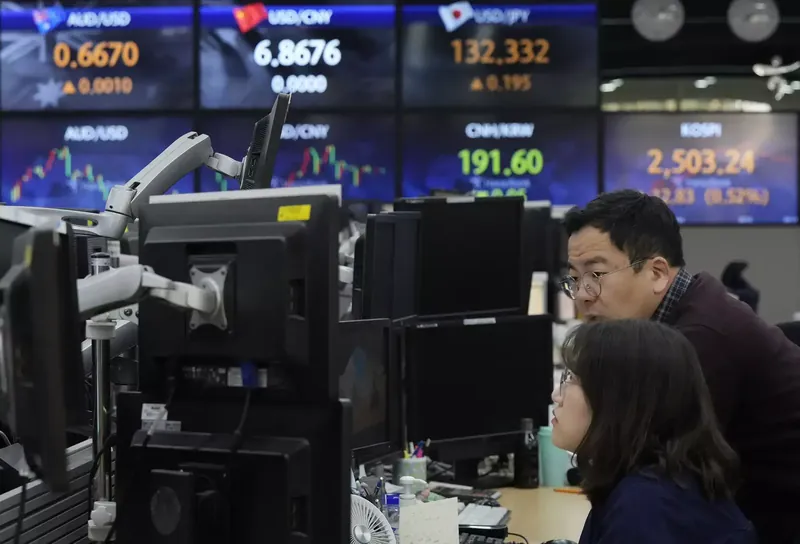
Contracts on the S&P 500 climbed 0.8% while a gauge of Asian stocks rose 0.5% on Thursday, following a significant development in US-Iran relations. The signing of a Memorandum of Understanding by former US President Donald Trump aims to reopen the Strait of Hormuz, potentially easing energy-related risks and inflation concerns.
Nasdaq futures surged over 1% after the US benchmark S&P 500 fell 1.2% on Wednesday, influenced by the Federal Reserve's indication of potential rate hikes to control inflation. Brent crude prices dropped more than 1% in early Asian trading, falling below $79 a barrel. The Fed's decision has also led to increased yields on Australian and Japanese bonds, mirroring a selloff in US Treasuries.
The Memorandum of Understanding, signed at the palace of Versailles near Paris, is now in effect, though it remains unclear if Iran has taken steps to fully reopen the Strait of Hormuz. This development is expected to support both bond and equity markets, according to Rajeev De Mello of Gama Asset Management.
“Trump’s signing of the Memorandum of Understanding following the G7 meeting represents another meaningful step toward reopening the Strait of Hormuz.”
Rajeev De Mello, global macro portfolio manager at Gama Asset Management
In the US, two-year Treasury yields, sensitive to Fed policy expectations, rose 13 basis points to 4.18%. Fed Chair Kevin Warsh, in his first press conference, emphasized the central bank's commitment to restoring price stability, noting that inflation has exceeded the 2% target for several years.
Central banks in Indonesia and the Philippines are anticipated to raise policy rates by a quarter-point each, as these economies have been affected by global oil price increases. The Fed's recent hawkish stance is not solely about energy prices but also reflects strong labor market and inflation data, according to Kay Haigh of Goldman Sachs Asset Management.
“Half the committee is expecting rate hikes this year, which is a real shot across the bow at the market.”
Bob Michele, chief investment officer and global head of fixed income at JPMorgan Asset Management
The yen weakened to its lowest level against the US dollar since July 2024, raising concerns about potential intervention. Investors worry that the central bank's policies may not be sufficient to contain inflation and stabilize the yen, despite recent rate hikes.
Background
The Fed's decision to maintain rates for the fourth consecutive meeting highlights its focus on inflation over labor market concerns. The creation of a task force to review the Fed's $6.7 trillion balance sheet indicates a strategic shift in monetary policy tools.
As markets adjust to the Fed's signals and geopolitical developments, investors will closely monitor further actions from the US and Iran regarding the Strait of Hormuz, as well as upcoming central bank decisions in Asia.