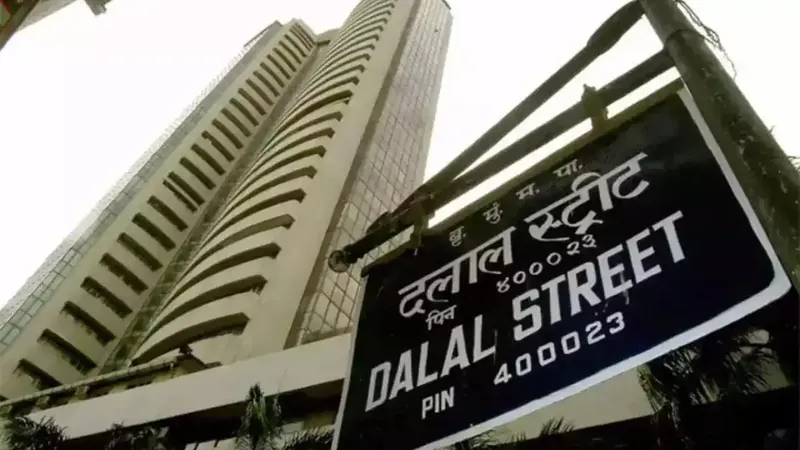
Indian stock markets witnessed a significant downturn on Monday as NSE's Nifty fell 243.7 points, or 1%, to close at 23,123, and BSE's Sensex declined 719.08 points, or 1%, to end at 73,524.26. The decline was driven by escalating geopolitical tensions between Iran and Israel and rising crude oil prices, which have unsettled investor sentiment.
The market opened lower following the news of attacks between Iran and Israel, highlighting the fragility of the truce in the region. The India Volatility Index (VIX), often referred to as the market's fear gauge, surged 7.85% to 17.03, indicating heightened market anxiety. Brent crude futures for August delivery rose by 1.5% to $94.5, adding to the pressure on the markets.
Pankaj Pandey, head of fundamental research at ICICI Direct, noted that the ongoing escalation in West Asia and a shift in global capital from AI-related stocks to other sectors ahead of the SpaceX IPO contributed to the sell-off in major Asian indices. Japan's market fell 3.9%, China declined 1.7%, Hong Kong dropped 1.2%, South Korea plummeted 8.3%, and Taiwan decreased by 3.5%.
“Indian markets weakened due to the ongoing escalation in West Asia, which continues to weigh on investor sentiment, as well as a rotation of global capital from AI-related stocks into other sectors ahead of the SpaceX IPO, which also led to a sell-off in major Asian indices.”
Pankaj Pandey, head of fundamental research, ICICI Direct
Broader market indices also suffered, with the Nifty Midcap 150 dropping 1.5% and the Nifty Small-cap 250 falling 1.8%. Out of 4,537 shares traded on the BSE, 1,181 advanced while 3,192 declined. According to Pabitro Mukherjee, deputy vice president-research at Bajaj Broking, Nifty is currently in a corrective trend, trading below its short-term averages.
Kush Gupta, fund manager at SKG Investments & Advisory, highlighted that geopolitical risk aversion, global AI portfolio rebalancing, and sideways earnings growth are the dominant near-term variables. He expects the broader market to remain range-bound in the near to medium term.
“We expect the broader market to remain range-bound in the near to medium term. Large and mid-caps offer better valuation comfort and stability, while small-caps could face greater pressure due to elevated valuations, thinner earnings buffers, and lower pricing power.”
Kush Gupta, fund manager, SKG Investments & Advisory
Background
The current market volatility is a reflection of broader geopolitical and economic uncertainties. Historically, such tensions have led to increased market volatility and investor caution, particularly in regions heavily reliant on oil imports.
Looking ahead, investors should monitor the geopolitical developments closely, as prolonged tensions could further impact market stability. Additionally, the trajectory of crude oil prices will be crucial in determining the cost pressures on Indian companies, potentially leading to price adjustments in the coming months.