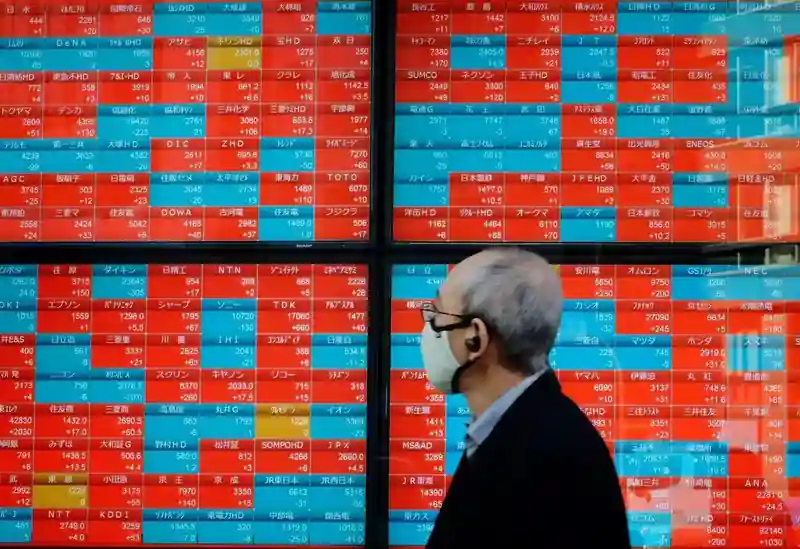
Japan's Nikkei index fell by 0.3% to 66,734.24 on Tuesday, recovering from an earlier 2% drop, as investors weighed the impact of fragile Middle East peace talks and rising oil prices. The broader Topix index also edged down 0.42% to 3,924.24.
The Nikkei had previously reached a record peak of 67,231.28 on Monday, with a closing high of 66,934.33, indicating a market that was 7% above the 25-day moving average. This sharp rally raised concerns of an overheated market. The uncertainty surrounding ceasefire talks between the U.S. and Iran, coupled with the potential reopening of the Strait of Hormuz, contributed to market volatility.
In the Japanese market, electronic components maker TDK and robot maker Fanuc both fell by 2%, exerting downward pressure on the Nikkei. Conversely, technology investor SoftBank Group ended 1% higher after a volatile trading session. Energy stocks, however, bucked the trend, with Inpex climbing 4.42% following overnight gains in oil prices. Mining stocks also surged, with a 3.75% increase, making it the top-performing sector on the Tokyo Stock Exchange.
“There was a caution for the Nikkei's sharp rally, and the optimism for the early end of the Middle East conflict weakened and the oil prices rose.”
Daisuke Hashizume, senior strategist at Daiwa Securities
Bank shares showed resilience, with Mitsubishi UFJ Financial Group and Mizuho Financial Group gaining 0.76% and 2.24%, respectively. Of the nearly 1,500 stocks trading on the TSE's prime section, 28% rose, 69% fell, and 2% traded flat.
"There was a caution for the Nikkei's sharp rally, and the optimism for the early end of the Middle East conflict weakened and the oil prices rose," said Daisuke Hashizume, senior strategist at Daiwa Securities.
Background
The recent developments in the Middle East, particularly the status of ceasefire talks between the U.S. and Iran, have significant implications for global markets. The Strait of Hormuz is a critical chokepoint for oil shipments, and any disruptions could impact energy prices worldwide.
Looking ahead, investors will be closely monitoring the progress of the U.S.-Iran talks and the potential impact on oil prices. The market's reaction to these geopolitical developments will be crucial in determining the Nikkei's future trajectory.