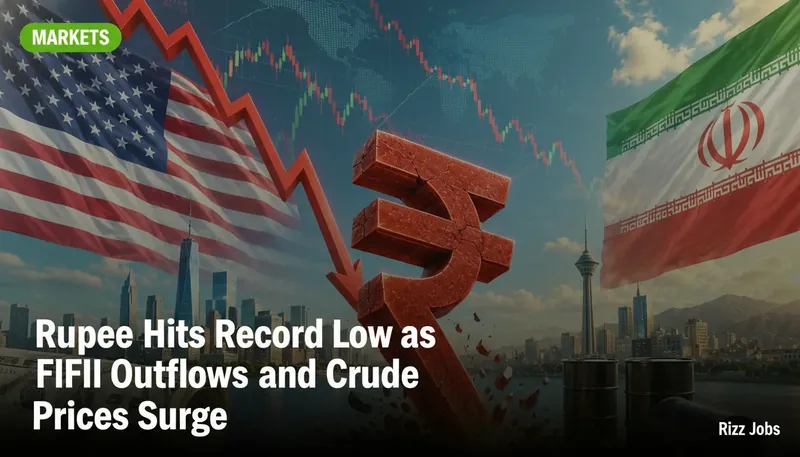
The Indian rupee fell by 30 paise on Tuesday, reaching a new low amid escalating foreign institutional investor (FII) outflows and rising crude oil prices. The currency has weakened over 6% since the onset of the Iran war on February 28, driven by global risk-off sentiment and a stronger dollar.
Foreign institutional investors have withdrawn Rs 2.65 lakh crore from Indian markets in 2026, nearing last year's total exit of Rs 3.04 lakh crore. This significant outflow has exerted downward pressure on the rupee, which has been exacerbated by elevated crude oil prices hovering around $110 per barrel.
The rupee's rapid decline since May 11 has surprised market participants, with experts warning of further depreciation. "The speed of the rupee’s descent since May 11 has caught the market off-guard. This downward pressure is fuelled by higher energy prices and aggressive FII capitulation," said KN Dey, a forex market consultant.
“The speed of the rupee’s descent since May 11 has caught the market off-guard. This downward pressure is fuelled by higher energy prices and aggressive FII capitulation.”
KN Dey, forex market consultant
Analysts suggest that the rupee could test the 97 level against the dollar if current trends persist. "Crude oil continues to hover around the $110 per barrel level. The market will be testing 97 against the $ in the absence of any positive development on the war front,” said Madan Sabnavis, chief economist, Bank of Baroda.
The local currency's weakness reflects persistent FII outflows, elevated crude prices, and safe-haven demand for the dollar amid global risk-off sentiment, according to Vinay Rajani, senior technical research analyst at HDFC Securities.
“Crude oil continues to hover around the $110 per barrel level. The market will be testing 97 against the $ in the absence of any positive development on the war front.”
Madan Sabnavis, chief economist, Bank of Baroda
Background
The rupee's decline is part of a broader trend of emerging market currencies facing pressure due to geopolitical tensions and rising energy costs. Historically, such conditions have led to increased volatility in currency markets.
Looking ahead, market participants will closely monitor geopolitical developments and energy price trends, as these factors will likely continue to influence the rupee's trajectory. A psychological slide to 100 cannot be ruled out if current pressures persist.