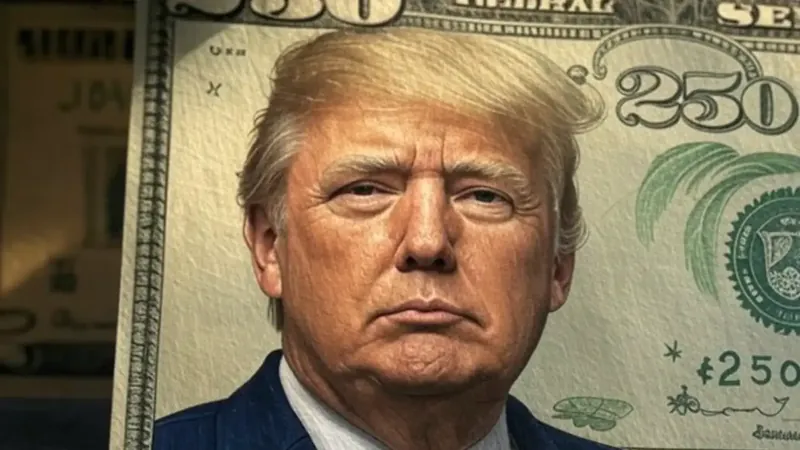
A proposal to feature Donald Trump's image on a new $250 bill was first reported by the Washington Post on Thursday. If enacted, it would mark the first time in 150 years that a living person, particularly a president, appears on US currency. The proposal is currently under consideration in both the House and the Senate.
US Treasury Secretary Scott Bessent confirmed the existence of the proposal, stating that the Treasury Department has made preparations for the potential legislative change, although they will adhere to existing laws. A design mock-up obtained by the Washington Post features the phrase "America 250 anniversary," commemorating the 250th anniversary of the United States' independence.
Concerns have been raised by employees at the Bureau of Engraving and Printing, who spoke anonymously to the Post, citing a federal law that prohibits living presidents from being depicted on US currency. Despite these concerns, the Trump administration has been actively pursuing the initiative.
“Right now there is proposed legislation -- front of the House, in front of the Senate -- to change the first requirement so that a living person, Donald J. Trump, could be on a $250 bill.”
Scott Bessent, US Treasury Secretary
The proposal has faced criticism from Democrats, with Senator Mark Warner describing it as an attempt by the White House to "stoke the president's ego." The legislation was introduced in Congress last year but has not advanced.
In addition to the proposed bill, the Trump administration has been involved in other initiatives to place Trump's name and likeness on various cultural institutions and items, sparking accusations of a cult of personality.
Background
The proposal to feature a living president on US currency is unprecedented in modern times and raises legal and ethical questions. Historically, US currency has featured deceased individuals, reflecting a longstanding tradition. The move is part of broader efforts by the Trump administration to cement the former president's legacy.
The outcome of this proposal remains uncertain, but it highlights the ongoing efforts by the Trump administration to leave a lasting mark on American culture and history. Observers will be watching closely to see if the legislation gains traction in Congress.