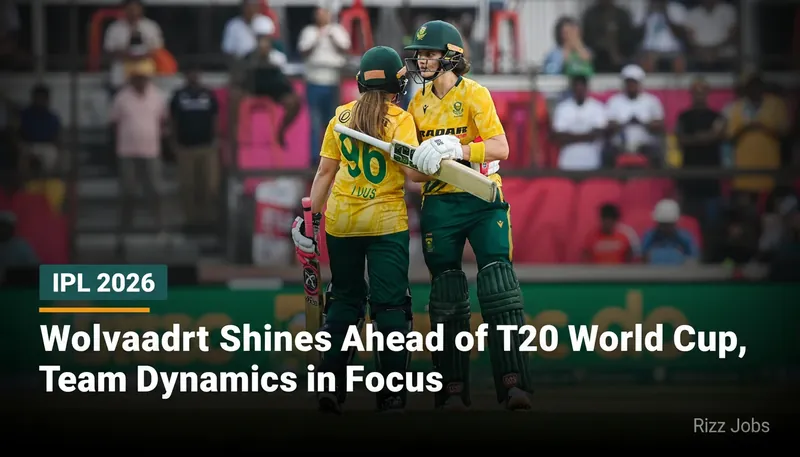
As the T20 World Cup looms on the horizon, South Africa's cricket team is grappling with the dual challenge of capitalizing on individual brilliance and fortifying team dynamics. Laura Wolvaardt, the T20I captain, has been in scintillating form, providing a beacon of hope for the team's prospects in the global tournament. Her recent performances have not only elevated her status but also set a benchmark for her teammates. However, Wolvaardt's individual success underscores a pressing issue: the need for stronger partnerships and impeccable fielding, particularly catching, to enhance the team's overall performance.
In the high-stakes environment of international cricket, where margins for error are minimal, the ability to forge crucial partnerships can be the difference between victory and defeat. Wolvaardt's call for bigger partnerships is a strategic move aimed at ensuring that the team can build substantial innings and apply pressure on opponents. This approach is not just about scoring runs but about creating a resilient batting order that can withstand the pressures of world-class bowling attacks.
Moreover, fielding, often considered the third dimension of cricket, can significantly influence match outcomes. Wolvaardt's emphasis on improved catching highlights a critical area where South Africa can gain a competitive edge. In a tournament where every run saved can tilt the balance, enhancing fielding skills could be pivotal.
For Indian investors and business readers, the dynamics of team sports like cricket can offer valuable insights into organizational behavior and performance management. The emphasis on partnerships and fielding parallels the corporate world’s focus on teamwork and operational efficiency. Just as in cricket, where individual talent needs to be harnessed for team success, businesses must integrate individual competencies into cohesive strategies to achieve organizational goals.
As South Africa prepares for the T20 World Cup, the team's ability to translate individual brilliance into collective success will be closely watched. For Wolvaardt, the challenge lies not just in leading by example but in galvanizing her team to rise to the occasion.